
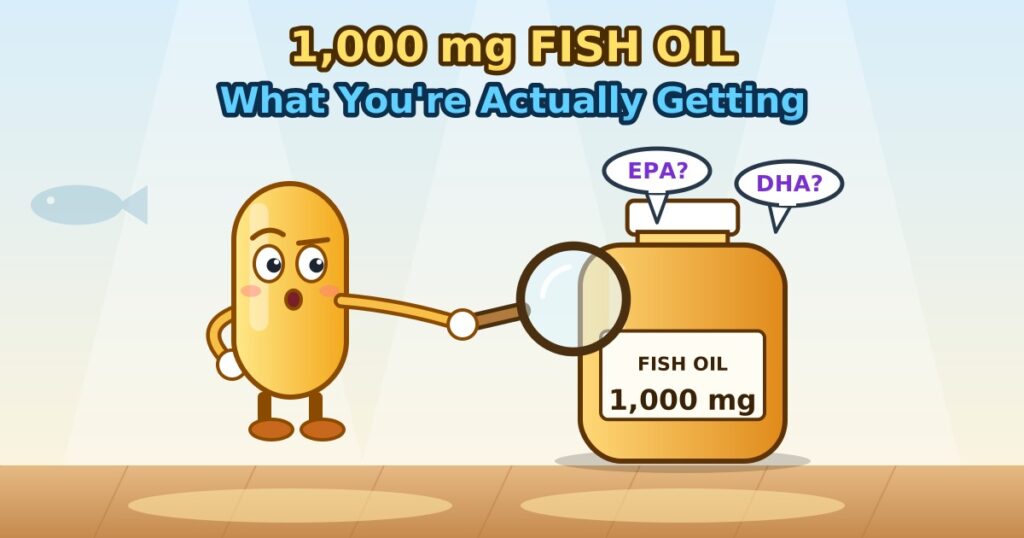
Search for 1000mg fish oil and you’ll find dozens of bottles with a big “1,000 mg” (or 1,200, or 2,500) printed on the front. It looks like a dose. For most of them, it isn’t the number that matters.
That figure is usually the weight of the oil in the softgel. The part you’re buying it for, EPA and DHA, is only a fraction of it, and the fraction can run from under a third to more than 80%. Here’s how to read the label, using real bottles.
The short version: “1,000 mg fish oil” is the weight of the oil, not the amount of EPA and DHA. Find the serving size, add the EPA and DHA from the Supplement Facts, divide by the number of softgels, and compare the cost per 1,000 mg of EPA + DHA. Last reviewed: October 2026.
What “1,000 mg” on a fish oil label actually measures
On most bottles it’s the total weight of fish oil in the capsule or serving. Fish oil contains many kinds of fat. EPA and DHA are the omega-3s most people take it for, and they’re listed separately on the Supplement Facts panel, usually just under the total.
That panel can hold three different numbers: the amount of oil, the total omega-3, and the EPA and DHA. Total omega-3 includes EPA, DHA, and smaller omega-3s such as DPA. Only EPA + DHA tells you how much of the two main omega-3s you’re getting.
Same “1,000 mg,” very different contents
Two softgels can both carry 1,000 mg of fish oil and still differ a lot. These two are illustrative. Bottle A matches how the NIH describes a typical fish oil supplement (about 1,000 mg of oil with 180 mg EPA and 120 mg DHA, per the NIH fact sheet), and concentrated oils like Bottle B are also sold:
| Bottle A (standard-strength) | Bottle B (concentrated) | |
|---|---|---|
| Fish oil per softgel | 1,000 mg | 1,000 mg |
| EPA | 180 mg | 500 mg |
| DHA | 120 mg | 250 mg |
| EPA + DHA | 300 mg | 750 mg |
| EPA + DHA as a share of the oil | 30% | 75% |
Bottle B gives you two and a half times the EPA and DHA from the same “1,000 mg.” Our guide From Ocean to Capsule goes deeper into how the oil is processed and why concentrations differ.
Real bottles, same trap
Here are three well-known products, using the Supplement Facts as retailers listed them in October 2026. Formulas change, so check the bottle you buy.
| Product | Number on the front | Serving size | EPA + DHA per serving | EPA + DHA per softgel |
|---|---|---|---|---|
| Viva Naturals Triple Strength | 2,500 mg fish oil | 2 softgels | 2,070 mg | 1,035 mg |
| Sports Research Triple Strength | 1,250 mg fish oil | 1 softgel | 950 mg | 950 mg |
| Nordic Naturals Ultimate Omega 2X | 2,150 mg omega-3 | 2 softgels | 2,000 mg | 1,000 mg |
Same softgel, different-looking numbers. Viva’s front says 2,500 mg of fish oil and Sports Research’s says 1,250 mg, which looks like double. But Viva’s number covers two softgels and Sports Research’s covers one. Per softgel, both hold 1,250 mg of oil, and all three land between 950 and 1,035 mg of EPA + DHA per softgel.
The real differences are the serving size, the price, and what else is on the label. We compare these bottles head to head in Sports Research vs. Viva Naturals and Nordic Naturals vs. Carlson Labs.
Wondering how fish oil compares with krill oil? See Fish Oil vs. Krill Oil: Which Gives You More EPA and DHA for the Money?
How to read any fish oil bottle in 4 steps
- Find the serving size. It’s printed at the top of the Supplement Facts and may be one softgel, two, or more.
- Add the EPA and DHA. Use those two lines, not the “fish oil” or “omega-3” total.
- Divide by the softgels per serving. That gives EPA + DHA per softgel.
- Compare cost per 1,000 mg of EPA + DHA. Divide the bottle price by (total softgels × EPA + DHA per softgel ÷ 1,000). Example: a $30 bottle of 60 softgels at 500 mg EPA + DHA each holds 30,000 mg, so it costs $1.00 per 1,000 mg.
For the full walk-through of the rest of the label, see How to Choose an Omega-3 Supplement Without Getting Lost in the Label.
“Omega-3 1000mg” isn’t the same as “1,000 mg fish oil”
Some bottles advertise an omega 3 1000mg figure instead. That’s the total omega-3 content, which is usually a little more than the EPA + DHA. Sports Research lists 1,040 mg of total omega-3 against 950 mg of EPA + DHA, and Viva lists 2,250 mg against 2,070 mg. The gap is smaller omega-3s such as DPA. Both numbers are useful, but only one tells you how much EPA and DHA you’re getting.
Is 1,000 mg enough?
There’s no single right dose. It depends on your diet, your health, and your doctor’s guidance, and this site doesn’t give medical advice. Our guide Vital Omega-3 Fatty Acids: Why Correct Dosage Matters covers what the research and official guidance say. If you take blood thinners or have a bleeding or heart-rhythm condition, ask your doctor before raising your intake.
Want fewer pills?
If taking two softgels a day is the sticking point, a liquid can deliver the same dose in one go. One teaspoon of Carlson’s liquid, for example, provides 1,300 mg of EPA + DHA. See our Carlson The Very Finest Fish Oil review.
Quick answers
Is 1,000 mg fish oil the same as 1,000 mg omega-3?
No. 1,000 mg of fish oil is the weight of the oil. The omega-3 content is a portion of it, and EPA + DHA is a portion of that.
How much EPA and DHA is in an omega 3 fish oil 1000mg softgel?
It depends on the product. A standard-strength oil often has about 300 mg of EPA + DHA (the NIH’s typical example is 180 + 120), while concentrated oils can reach 750 mg or more from the same 1,000 mg of oil. The Supplement Facts panel gives the exact figure.
Does a bigger number on the front mean a stronger fish oil?
Not by itself. Check the serving size first, then compare EPA + DHA per softgel and cost per 1,000 mg.