
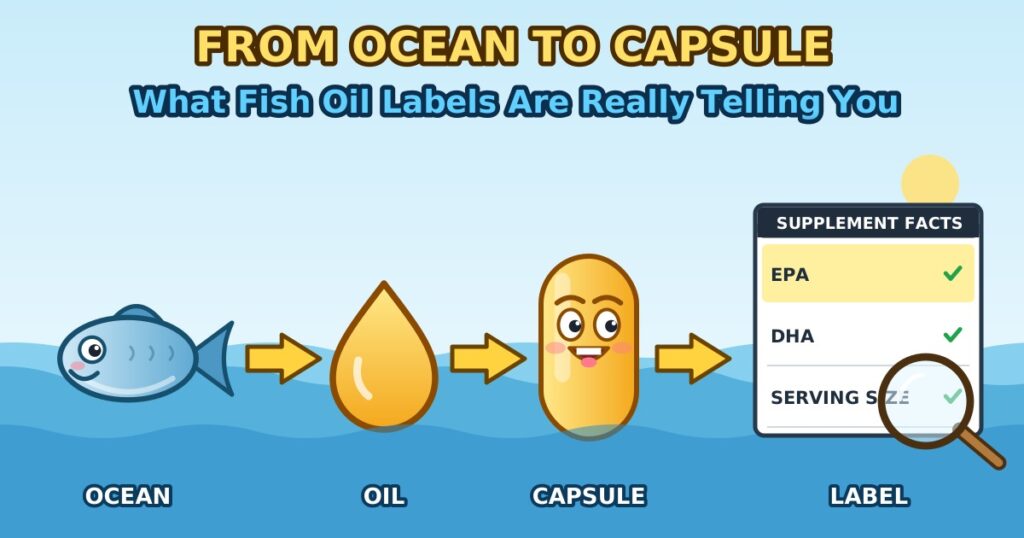
The fish-oil capsule is one of the most ordinary objects in the modern medicine cabinet: small, glossy, faintly amber, and often accompanied by more promises than explanations. This is the longer story of what is inside it—where it begins, what EPA and DHA actually are, why two bottles that look alike may not be alike at all, and how to read a label without allowing the label to do all the thinking for you.
The short version: The big number on the front of a fish oil bottle is usually the total oil, not the EPA and DHA. Turn the bottle around, find EPA and DHA in the Supplement Facts, add them, and check whether the total is per capsule or per serving. Then look for evidence of freshness and testing, and compare cost per 1,000 mg of EPA + DHA. Last reviewed: October 2026.
There is a particular kind of confusion that happens in the supplement aisle.
You pick up a bottle of fish oil. The front is busy with large numbers, clean blue water, fish silhouettes, perhaps a boast about purity or potency. Somewhere on the label are phrases such as “1,000 mg,” “triple strength,” “molecularly distilled,” “burp-less,” “ultra omega,” or “advanced EPA and DHA.”
The bottle seems to be explaining itself. Usually, it is not.
It is selling you a feeling of clarity. The actual clarity is printed in smaller type on the back: the Supplement Facts panel, the ingredient list, the suggested serving size, and, sometimes, the details the bottle does not provide at all.
A fish-oil capsule is the last visible point in a very long chain. Before it was a capsule, it was oil. Before it was oil, it was part of a fish. Before it was part of a fish, it was part of the food web of the sea. And before that, in an important sense, it began with microscopic algae.
To understand a fish-oil supplement, it helps to travel backward before moving forward.
Not because everyone needs a degree in marine biology to choose a supplement. They do not. But because a little context prevents a great deal of confusion. It helps explain why the words EPA and DHA matter more than the huge number on the front of the bottle, why fish oil and omega-3 are related but not identical, why freshness deserves attention, and why the best decision is rarely made by chasing the loudest claim.
The story does not begin with fish
Fish are famous for omega-3, but they are not where the story begins.
At the base of the marine food chain are microscopic algae. Some marine algae produce the long-chain omega-3 fats known as EPA and DHA. Tiny organisms consume the algae; small fish consume those organisms; larger fish consume smaller fish. Along the way, EPA and DHA become part of the tissues and oils of marine animals.
That is why salmon, sardines, anchovies, herring, mackerel and other oily fish are associated with omega-3. The fish are not simply small underwater factories manufacturing a fashionable nutrient. They are part of an ecological chain that concentrates it. Small oily fish low on that chain—anchovies, sardines, herring—are commonly used for supplements, and their source fishery can be named and checked.
It is also why algae oil exists.
An algae-oil supplement is not an imitation of fish oil in the way a synthetic orange drink imitates an orange. It can go closer to the beginning of the marine chain: directly to algae, the original producers of the EPA and DHA that later appear in fish. For people who do not eat fish, or who prefer to avoid fish-derived supplements, algae-derived EPA and DHA are a serious part of the larger omega-3 picture.
For real-label examples and a comparison, see Vegan Omega-3 Supplements.
The term “omega-3” itself covers a family of fats rather than one single substance. Three names matter most:
- ALA, or alpha-linolenic acid
- EPA, or eicosapentaenoic acid
- DHA, or docosahexaenoic acid
ALA is found primarily in plant foods and oils, including flaxseed, chia seeds, walnuts, canola oil and soy. EPA and DHA occur chiefly in fish, seafood and algae-based products. The body can convert some ALA into EPA and DHA, but the conversion is limited and varies considerably between people. That does not make ALA unimportant; it means that a tablespoon of flax oil and a serving of salmon are not simply interchangeable units of the same thing.
This distinction is worth understanding before anyone tells you which bottle to buy.
EPA and DHA: the names worth finding
Most people say “fish oil” when they really mean “omega-3.”
It is an understandable shortcut, but it obscures the thing the reader usually wants to know. Fish oil is a broad ingredient. EPA and DHA are two of the principal omega-3 fats within it.
Think of it this way: “fish oil” tells you the broad category of oil in the bottle. EPA and DHA tell you more specifically what the oil is delivering.
EPA—eicosapentaenoic acid—is the long name that often disappears behind three letters. DHA—docosahexaenoic acid—is its better-known companion. Both are long-chain polyunsaturated omega-3 fatty acids. Both are found in marine foods and can be supplied by fish oil or algae oil. Both appear on labels in milligrams.
This is where the label begins to become more informative than the bottle front.
A front label may announce:
1,000 mg Fish Oil
That sounds decisive. It is not necessarily decisive.
“For a real-bottle example, see what’s actually in a 1,000 mg fish oil.”
The number may refer to the total amount of fish oil in a capsule. Within that oil may be a smaller amount of EPA and DHA. Or it may be a much larger amount. Two products can both say “1,000 mg fish oil” and be quite different in the actual EPA and DHA they provide.
Here is a simplified example.
| Bottle A | Bottle B | |
|---|---|---|
| Fish oil per serving | 1,000 mg | 1,000 mg |
| EPA per serving | 180 mg | 500 mg |
| DHA per serving | 120 mg | 250 mg |
| Combined EPA + DHA | 300 mg | 750 mg |
The front of both bottles may look remarkably similar. The contents are not.
Bottle A contains 1,000 mg of fish oil, of which 300 mg is EPA plus DHA. Bottle B contains 1,000 mg of fish oil, of which 750 mg is EPA plus DHA. Neither number is inherently dishonest. They are answering different questions. But only one tells you directly how much EPA and DHA are present.
The useful habit is almost comically simple: turn the bottle around, find EPA, find DHA, add them, and check whether that total is per capsule or per serving of two or three. A person comparing front labels alone can easily compare one capsule of one product with two capsules of another without realizing it.
A real example: same softgel, two different-looking numbers
Viva Naturals Triple Strength lists 2,500 mg fish oil on the bottle. Sports Research Triple Strength lists 1,250 mg fish oil. That looks like double, but Viva’s number covers a serving of two softgels and Sports Research’s covers one. Per softgel, both hold 1,250 mg of oil.
The EPA + DHA per serving is where they differ: 2,070 mg for Viva (2 softgels) against 950 mg for Sports Research (1 softgel). The full comparison, with cost per 1,000 mg, is in Sports Research vs. Viva Naturals.
The arithmetic is not glamorous. It is the difference between knowing what you are looking at and merely recognizing familiar words. For a more practical walk-through of serving sizes and the marketing clutter around them, see How to Choose an Omega-3 Supplement Without Getting Lost in the Label.
What the other front-label words usually mean
A few of those phrases deserve a plain translation before they are set aside.
“High potency” and “concentrated” usually point to how much of the oil is actually EPA and DHA. A less concentrated product may require several capsules to provide a given amount. A more concentrated product may provide more per capsule, which can matter if you dislike swallowing several, or if you are comparing cost per milligram of EPA and DHA rather than cost per bottle. Neither word is a verdict on the product’s fitness for every person.
“Molecularly distilled” describes a purification step used to separate and concentrate fatty acids and to reduce certain contaminants. It is a process, not a proof. It does not tell you the EPA and DHA dose, the species, or whether this batch was tested after it was bottled.
“Burp-less” is a comfort claim, not a potency claim. It may refer to an enteric coating meant to delay release until the capsule has passed the stomach, to a flavor meant to mask taste, or simply to oil that has not gone off. Coatings and flavors can hide a problem as easily as they solve one. Freshness is the more useful question, and it is treated separately below. If aftertaste is the main concern, How to Prevent Fish Oil Burps: Enteric Coatings vs. Freshness Matrix takes that distinction further.
Concentration answers one question: how much EPA and DHA is present relative to the total oil? It does not answer the others a thoughtful person might have. What species or source was used? How transparent is the manufacturer? Is the serving size realistic? How was the oil processed and stored? What does it cost per meaningful amount of EPA and DHA? Does it fit the person’s diet and reason for taking it?
A respectable label helps you ask those questions. It does not punish you for doing so.
Fish oil is not a medical diagnosis
Supplement marketing has a way of making people feel that every bottle is secretly a prescription waiting to be discovered.
It is not.
Fish oil is a dietary supplement. EPA and DHA are nutrients with substantial scientific interest and long histories of study, but that does not mean any bottle on a shelf should be treated as a universal answer to health, mood, joints, memory, circulation, inflammation or whatever other human anxiety happens to be printed beside a picture of a heart.
The evidence around omega-3 is wide, complex and highly dependent on the question being asked: the population studied, the amount of EPA and DHA used, whether participants already ate fish, whether they had a particular medical condition, what outcome researchers measured, and how long the study lasted.
This is one reason headlines about fish oil can feel contradictory. One week, fish oil is celebrated. The next, it is dismissed. The truth is rarely contained by either headline.
It is more useful to ask:
- Is this claim about food, a general supplement, or a prescription omega-3 product?
- Is it based on a population with a diagnosed condition, or on the general public?
- What dose was actually studied?
- Was the result substantial, modest, mixed or uncertain?
- Is a company using a sliver of evidence to make a much larger promise?
The U.S. Food and Drug Administration has allowed certain qualified health claims about EPA and DHA in specific contexts (see its letter). The word qualified matters. It means the evidence and language have limits; it is not a blank check for a supplement label to imply certainty where certainty does not exist.
If you take prescription medication, have a medical condition, are pregnant, have surgery planned, or are considering a high-dose omega-3 regimen, that is a discussion worth having with a clinician who knows your history. A supplement article can help you ask better questions. It should not pretend to replace the people qualified to answer them in the particulars of your own life.
For the practical question of how labels present intake and why “per serving” deserves attention, continue with Vital Omega-3 Fatty Acids: Why Correct Dosage Matters.
The forms of fish oil: useful knowledge, not a new religion
Once a reader gets past EPA and DHA, another vocabulary tends to arrive: triglycerides, ethyl esters, re-esterified triglycerides, phospholipids, phosphatidylcholine, absorption, bioavailability.
This is the part of the subject where supplement culture can become strangely theological. Every form acquires disciples. Every manufacturer has a preferred explanation. Every distinction is presented as decisive.
The distinctions are real. They can matter. But not all meaningful details are equally important for every person.
Triglyceride form. In foods, many fats naturally occur as triglycerides. Fish oil can also be sold in triglyceride form. Some products use a re-esterified triglyceride form after processing and concentration. You may see this described as “TG” or “rTG.”
Ethyl ester form. Ethyl ester forms are often created during processing, especially when producers concentrate specific fatty acids. This form is not automatically sinister, inferior or unsafe because it sounds industrial. It is simply one chemical form used in some fish-oil products, including products designed to provide a high concentration of EPA and DHA.
Phospholipid-bound omega-3. Krill oil is often discussed here because some of its omega-3 fats are associated with phospholipids. This is a real difference in structure, but the front-label mystique around it can outrun its practical importance for an ordinary consumer. Krill products also often provide less EPA and DHA per capsule than a concentrated fish oil, which brings the comparison back to the numbers.
If you are standing in front of a shelf, forms are not nothing. They are usually not the first question. Amount, serving size, source, and evidence of quality come before the chemical form. That order saves a person from being talked into a technical debate before they have read the basic numbers.
The quiet question of freshness
The product’s journey does not end when the capsule is manufactured.
Fish oil, algae oil and other oils rich in polyunsaturated fats are vulnerable to oxidation. In plain language: over time, especially with exposure to oxygen, heat and light, the oil can deteriorate. Temperature, light, oxygen exposure, moisture, trace metals, product formulation and storage conditions all affect how quickly this can happen.
Laboratories describe that deterioration with a few standard markers. Peroxide value reflects early-stage oxidation. Anisidine value reflects later-stage breakdown products. TOTOX, a total oxidation figure, combines the two. Published surveys have found retail fish oils that miss their label claims or exceed oxidation recommendations, and others that do not. The spread is the point. A 2024 study in Dietetics found that 6 of 15 US fish oil products had EPA more than 20% away from the label claim, and 10 of 15 had DHA outside that range (study). An earlier New Zealand study, reported by The Conversation, found that 92% of the capsules tested for oxidation exceeded at least one international recommendation (summary in The Conversation). Oxidation is a real quality issue, not a reason to treat every capsule as a small emergency.
The practical signs are familiar even to people who have never used those terms:
- A smell that is aggressively fishy, stale, sharp, paint-like or rancid.
- An unpleasant aftertaste.
- Oil that seems somehow old, harsh or “off.”
- A product that has spent too long in heat, direct light or poor storage conditions.
Not every fishy burp means a product is rancid. Fish oil comes from fish; some aftertaste can arise simply from the capsule returning after it has been swallowed. Equally, a flavored product can mask unpleasantness rather than resolve it. Sensory experience is useful information, not a laboratory analysis.
Heat, light and oxygen are the usual enemies of these oils, which is why the storage directions on the label are worth following. Taste and smell tend to follow the chemistry.
A few practical habits follow naturally:
- Do not leave a bottle in a hot car, on a bright windowsill or near a heat source.
- Read the storage instructions supplied by the manufacturer.
- Close the bottle properly.
- Pay attention to expiry dates and, where provided, lot information.
- Treat an unmistakably rancid smell or taste as a reason to stop and investigate, rather than something to heroically endure.
- Do not buy enormous quantities merely because the per-capsule price seems attractive if you are unlikely to use them before they age.
What “quality” looks like when it is more than a word
“Pure,” “premium” and “pharmaceutical grade” are moods. Evidence is more specific, and a label or a company site can either offer it or not.
Useful details include the species, or a clear statement that the oil is from algae; a named region or fishery, and any sustainability certification the producer actually holds; the form of the oil; and batch-level testing rather than a standing claim that the brand is generally careful. The tests that matter for this category are the oxidation markers above, plus contaminants that can travel with marine oil: heavy metals such as mercury, lead and arsenic, and persistent organic pollutants such as PCBs and dioxin-like compounds. Third-party programs—among them IFOS, USP, NSF and equivalent independent labs—publish or certify results against stated limits. A company that shares a lot number and a current certificate gives you more to work with than one that asks for trust on the strength of a blue wave.
Absence of that information is not proof of a bad oil. It is a reason to keep reading, or to choose the bottle that answers more of the questions.
A capsule is not the whole ocean
It is easy to let the supplement aisle make capsules seem like the main stage and food like the understudy.
That reverses the order of things.
Fish and seafood are foods. They contain protein, vitamins, minerals and other compounds alongside EPA and DHA. A fish-oil capsule provides a more narrowed offering: primarily an extracted oil, often refined and concentrated, sometimes flavored or encapsulated for convenience.
For many people, the question is not fish or capsules. It is more ordinary than that:
- How often do I eat fish or seafood?
- Do I enjoy it?
- Is it available and affordable where I live?
- Do I have dietary, ethical, cultural or environmental reasons to avoid it?
- If I use a supplement, what gap am I trying to fill?
- Is the supplement a practical addition, or am I using it to avoid looking at the rest of my diet?
The FDA’s advice about eating fish describes fish as part of a healthy eating pattern and points people who are pregnant, breastfeeding or feeding children to lower-mercury “Best Choices.”
For people who do not eat fish, plant foods still have genuine value. Flaxseed, chia seeds and walnuts contribute ALA. They belong in a good diet on their own terms. The limited conversion of ALA to EPA and DHA simply means that a person who wants direct preformed EPA and DHA may consider algae-derived sources rather than assuming that all omega-3 labels mean the same thing.
The goal is not to create a hierarchy of moral virtue between salmon, sardines, walnuts, algae oil and capsules.
The goal is to understand what each actually provides.
How to read the bottle without being bullied by it
By now, the fish-oil bottle has become less mysterious.
It is no longer a tiny sealed symbol of “heart health” or “brain health” or “premium wellness.” It is a container holding a particular oil, in a particular form, in a particular amount, under particular storage conditions, with particular claims made on its behalf.
When you pick up a bottle, ask these questions quietly and in order.
- What is the serving size? One capsule? Two? A teaspoon? A serving size can make a dramatic difference in how impressive the front-label number appears.
- How much EPA does it contain? Find the line that says EPA or eicosapentaenoic acid. Note the amount per serving.
- How much DHA does it contain? Find the line that says DHA or docosahexaenoic acid. Note the amount per serving.
- What is the combined EPA + DHA total? Add the two. This is often the clearest practical measure of what the product provides, and the right basis for comparing cost.
- How much of the “fish oil” number is something other than EPA and DHA? This is not necessarily a problem. It tells you whether the product is more or less concentrated.
- Is the source clear? Does the product name the fish, or the algal species, or leave you with vague imagery and a generic claim of “marine lipids”?
- What does it tell you about quality? Look for oxidation results, contaminant testing, a lot number, or a third-party certificate—not the words “pure” and “premium” on their own.
- Is the bottle asking you to believe too much? A good supplement label should inform you. A bad one tries to make you anxious, dazzled or dependent.
The right product is not necessarily the bottle with the most heroic story. It may simply be the one whose contents, serving size, quality information and cost you can understand without needing to be talked out of your own common sense.
The point is not to become suspicious of everything
Learning to read a fish-oil label should not turn a person into an amateur detective who can no longer buy a bottle of anything without suspecting a cover-up.
The point is more modest.
You do not need to memorize the marine food chain. You do not need to become an expert in lipid chemistry. You do not need to treat every molecular form as a referendum on your intelligence.
You only need enough understanding to see through the fog.
Fish oil is oil from fish. Its most discussed long-chain omega-3 components are EPA and DHA. The large number on the bottle may refer to total oil rather than the amount of EPA and DHA. The Supplement Facts panel is therefore more revealing than the advertising on the front. Freshness, contaminants and storage deserve attention, and they can be checked rather than assumed. Food remains part of the story. Supplements can be useful tools, but they are not magical objects and should not be asked to perform magic.
The capsule in your hand is a small thing. The journey behind it is not.
It begins in the ocean—with algae, plankton, fish and time. It passes through nets, tanks, factories, laboratories, bottles and marketing departments. It ends, for the moment, on a shelf or in a cupboard, waiting for someone to decide whether the label deserves belief.
The best reader is not the one who believes the least.
It is the one who knows what questions to ask.
How to Choose an Omega-3 Supplement Without Getting Lost in the Label – Omeg3
Where to go next
- Sports Research vs. Viva Naturals: one softgel vs. a two-softgel dose, compared on EPA + DHA and cost per 1,000 mg
- Nordic Naturals vs. Carlson Labs: rTG form vs. IFOS-certified, compared on cost per dose
- Carlson The Very Finest Fish Oil Review: a liquid option if you dislike capsules