
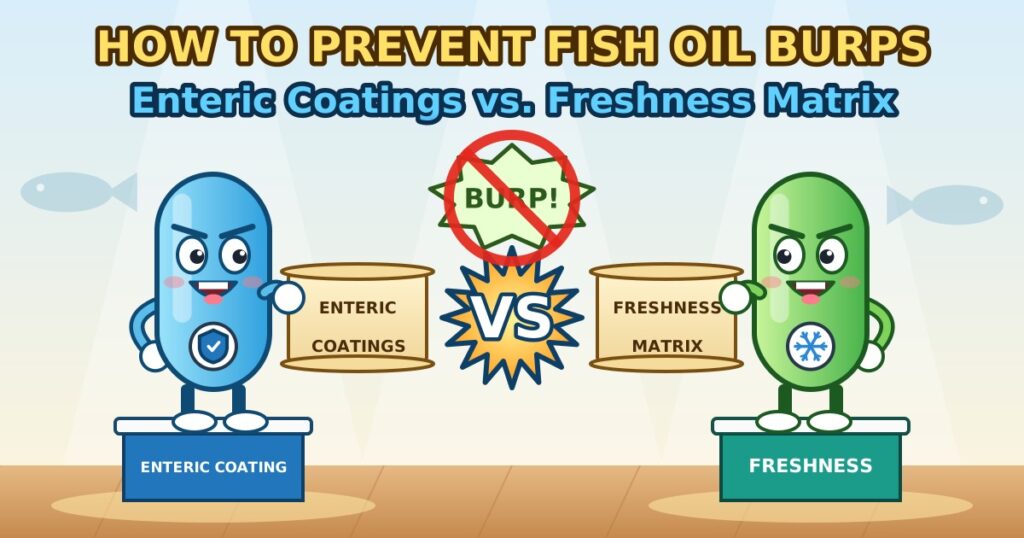
Few things take the fun out of a daily supplement like a fishy burp an hour after taking it. It is a common complaint, and it is not something you necessarily have to live with. This post sticks to what we can support: what the NIH says about side effects, what freshness testing measures, what an enteric coating is, and a few low-risk things to try. It is not medical advice.
What the NIH says about side effects
The NIH Office of Dietary Supplements lists the commonly reported side effects of omega-3 supplements as usually mild, including an unpleasant taste in the mouth, bad breath, heartburn, nausea and stomach discomfort (NIH fact sheet). It does not discuss burping specifically or say what causes it, and we are not aware of a study that settles the cause either. What follows is practical context, not a promise that any step will work for you.
Check freshness first
Omega-3 oils are unsaturated fats, and they can oxidize. Labs measure this with the peroxide value, the anisidine value and TOTOX, which is twice the peroxide value plus the anisidine value. Lower is fresher. GOED’s voluntary standard allows a TOTOX of up to 26, and the IFOS reports for Carlson Elite Omega-3 Gems list a limit of 19.5 (three real lots measured 17.4 to 17.7; see our Nordic Naturals vs. Carlson Labs comparison).
Freshness is worth checking because retail products do not always match their labels or recommendations. A New Zealand study reported by The Conversation found that 92% of the capsules tested exceeded at least one international oxidation recommendation (The Conversation summary). That is an older study of products from that time, and it does not tell you about the bottle in your cupboard. A sharp, stale or paint-like smell, or an aggressively fishy taste, is a reasonable reason to stop using that bottle.
What an enteric coating is, and what we can and cannot say
Some fish oil softgels are sold as “enteric coated.” An enteric coating is designed to stay intact in the stomach and dissolve further along, in the intestine. The idea is that less oil is released in the stomach. We can describe the design. We cannot point to a trial showing that it reduces burping more than other approaches, so treat it as something to try rather than a fix. A coating also tells you nothing about how fresh the oil inside is.
Things people try
None of these is backed by a study we can cite, and none replaces advice from a pharmacist or doctor. They are low-risk ideas:
- Follow the label directions. Many labels say to take the product with food. For example, the Carlson Elite Omega-3 Gems label says to take two softgels once daily at mealtime.
- Store it as the label says. Some products, such as Carlson’s liquid, say to refrigerate after opening. Only refrigerate a product if its label tells you to.
- Try a different brand or form. Liquid, softgel and algae oil products differ in oil, flavoring and coatings. Algae oil is a fish-free option (see our vegan omega-3 guide).
- Check your dose. If your daily dose is several softgels, ask your pharmacist or doctor whether it is appropriate to adjust or split it.
Oil form (re-esterified triglyceride versus ethyl ester) made a difference to absorption in a 2010 trial of 72 volunteers (Dyerberg et al.). That trial measured blood levels, not burping, so we do not treat oil form as a burp fix.
When to ask a professional
If you have persistent heartburn, nausea or stomach discomfort, or you take blood thinners or other medicines, talk to your doctor or pharmacist before changing how you take omega-3 supplements. For help comparing products on the numbers that matter, see How to Choose an Omega-3 Supplement Without Getting Lost in the Label, our Sports Research vs. Viva Naturals comparison, and the Carlson The Very Finest Fish Oil review if you are considering a liquid.