
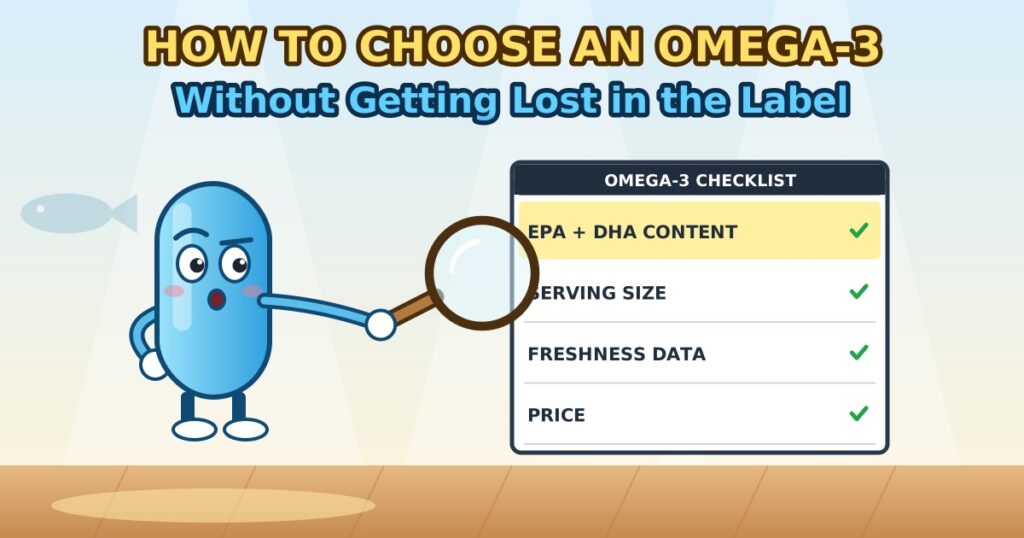
Buying an omega-3 supplement ought to be straightforward. Instead, a quick look at the shelf—or an online marketplace—produces a familiar fog of “triple strength,” “molecularly distilled,” “pharmaceutical grade,” lemon flavor, enormous milligram numbers, confident claims that make comparing products no easier.
The first rule is simple: do not choose from the front label. Compare the EPA and DHA amounts instead.
A bottle that announces “1,000 mg fish oil” may contain a fairly modest amount of the marine omega-3 fats people usually compare: EPA and DHA. Another bottle may cost more, contain fewer capsules, and still offer better value because it supplies more EPA and DHA per serving.
This guide is not about finding one universally “best” fish oil. That is usually the wrong question. It is about learning which details matter, what the label does and does not tell you, and how to compare products without paying for a large number that turns out to mean very little.
Start with EPA and DHA, not the oil weight
Omega-3 is a family name, not one single substance. The three names most buyers encounter are ALA, EPA and DHA.
ALA—alpha-linolenic acid—is found mainly in plant foods and oils, including flaxseed, soybean and canola. EPA and DHA are the long-chain marine omega-3s found in fish, seafood and algae-based supplements. ALA has its place in a normal diet, but it is not interchangeable with a product that directly provides EPA and DHA.
That distinction matters because supplement labels often feature the total amount of fish oil rather than the amount of EPA and DHA inside it.
A label might say:
Fish oil concentrate: 1,000 mg
That line tells you only the weight of the oil. It does not tell you how much EPA and DHA you receive. The information that matters is usually further down the Supplement Facts panel.
| What you see on the bottle | What to check instead | Why it matters |
|---|---|---|
| “1,000 mg fish oil” | EPA and DHA per serving | Oil weight is not the same as usable EPA+DHA content |
| “Triple strength” | Exact milligrams of EPA and DHA | “Strength” has no value until the dose is visible |
| “One softgel daily” | Whether one softgel actually supplies the stated amount | A serving can be one capsule, two capsules or more |
| “Plant-based omega-3” | Which omega-3s the product supplies: ALA, EPA, DHA or a combination | The source does not tell you the fatty-acid profile |
| “High potency” | Total EPA+DHA per serving and per bottle | Concentration is what makes a fair comparison possible |
A sensible comparison starts by recording four figures for each product:
- EPA per serving.
- DHA per serving.
- Combined EPA+DHA per serving.
- Number of servings in the bottle.
Everything else comes afterward.
If you are comparing high-strength fish-oil options, see how this plays out in the detailed comparison of Sports Research vs. Viva Naturals.
Decide what kind of omega-3 product you want
There is no point in buying fish oil if you do not want a fish-derived product, just as there is no point in choosing algae oil simply because it sounds more modern. Start with the source that fits your dietary preference and then compare the actual EPA/DHA dose, formulation and price.
Fish oil
Fish oil is the most familiar choice. It can provide substantial amounts of EPA and DHA in a relatively small number of capsules, particularly in concentrated products.
But “fish oil” is a broad category. Two products can both be called fish oil while differing sharply in EPA/DHA concentration, capsule count, flavor, source species, transparency of testing and cost per useful dose.
For a close look at one established product, read the review of Carlson The Very Finest Fish Oil. If you are deciding between Carlson and Nordic Naturals rather than considering one bottle in isolation, the more relevant read is Nordic Naturals vs. Carlson Labs.
Algae oil
Algae oil is the direct vegan alternative for people who want EPA and DHA without fish. It is not merely “flax oil in a capsule.” Algae are the original source of the long-chain omega-3s that enter marine food chains.
What matters is the formula. Some algae-oil products are primarily DHA products; others contain both DHA and EPA. That may be entirely appropriate depending on the buyer’s aim, but it makes label reading just as important as it is with fish oil.
A vegan label is a dietary qualification, not a guarantee that two products are equivalent.
For two real algae-oil labels side by side, see Vegan Omega-3 Supplements: How to Choose an Algae Oil.
Krill oil and other formats
Krill oil, cod liver oil, phospholipid formulations and emulsified liquids all come with their own practical questions. Some people prefer a particular format; others find one is easier to tolerate. Those can be valid considerations. They do not remove the need to check the EPA and DHA content, the serving size and the cost of the actual dose.
The format is part of the decision. It is not the whole decision.
Concentration changes the economics
A low price can be a bargain. It can also be an illusion.
Suppose Product A costs less but contains only a modest amount of EPA and DHA per capsule. Product B costs more but is considerably more concentrated. The relevant calculation is not the price of the bottle or even the cost per capsule. It is the cost of the omega-3 content you are actually buying.
A simple way to compare is:
Cost per 1,000 mg EPA + DHA = bottle price ÷ (total EPA + DHA in the bottle, in mg, ÷ 1,000)
For example, if a bottle costs $30 and contains 30 servings of 1,000 mg combined EPA+DHA, its cost per 1,000 mg EPA+DHA is $1. If another $30 bottle contains 60 servings of 500 mg combined EPA+DHA, the result is also $1 per 1,000 mg. The bottles are different, but on that measure their value is the same.
This is not a command to buy the cheapest option. Taste, capsule size, testing documentation, dietary preference, packaging, shipping, and how consistently you are likely to take it all matter. It is simply a way to stop the price tag from doing the thinking for you.
The Sports Research vs. Viva Naturals comparison is useful here because it places two high-potency products side by side rather than treating the largest headline number as a verdict.
Oil form matters, but it is not a religion
Omega-3 discussions often become fixated on abbreviations: TG, rTG and EE.
These refer to chemical forms of omega-3 oil:
- TG means triglyceride.
- rTG means re-esterified triglyceride.
- EE means ethyl ester.
The forms can matter to some buyers, and they are reasonable details to include in a careful comparison. But it is a mistake to let one abbreviation decide the entire purchase.
A strong product should still be judged by the dose it provides, the clarity of its label, the quality of its documentation, its freshness information, its price per meaningful amount of EPA+DHA, and whether it fits the person using it. A form claim does not make an under-dosed or poorly documented product a good choice. Nor does a particular form automatically make one brand appropriate for everyone.
The detailed form, dose and product-data comparison between Nordic Naturals and Carlson Labs is a better place to examine those distinctions product by product.
Freshness is more useful than a heroic-sounding slogan
Omega-3 oils are unsaturated fats. They can oxidize. That is one reason a serious buyer should take freshness seriously.
Manufacturers may refer to peroxide value, anisidine value or TOTOX. In broad terms, these are measures used to assess oxidation. TOTOX combines peroxide and anisidine measures into a single figure:
TOTOX = 2 × peroxide value + anisidine value
A measured result is a better starting point than vague language about “purity” or “advanced processing.” But the number itself should be read with some common sense.
Ask:
- Is the figure tied to a specific product or batch?
- Is there a date associated with the report?
- Is the documentation available to inspect?
- Does the company explain what is being measured?
- Is the claim current, or has it been copied from an old product page?
A company saying that an oil is “fresh” is marketing. A test result with accessible context is evidence. Neither one replaces proper storage after the product arrives in your home.
Keep omega-3 supplements according to the maker’s storage instructions. Avoid using products that are past their date, badly damaged, leaking, or plainly off in smell or taste. At the same time, do not assume that a neutral smell proves laboratory-grade freshness. Human senses are useful, but they are not a certificate of analysis.
Do not mistake more for better
A concentrated omega-3 product can be useful because it reduces capsule count and makes it easier to compare EPA and DHA. That does not mean everyone needs the largest dose available.
A product comparison can show what is in the bottle. It cannot determine what dose is appropriate for your personal health situation.
The FDA has concluded that dietary supplements providing no more than 5 g a day of EPA and DHA combined are safe when used as recommended, and has said it cannot determine safety above that amount. That is a safety finding, not a recommended dose, and it is not an invitation to aim for the ceiling: a bigger number on the label is not automatically a better decision. NIH guidance on omega-3
If you take anticoagulant or antiplatelet medication, have a bleeding disorder, are preparing for surgery, are pregnant or breastfeeding, or are managing an ongoing medical condition, speak to the clinician or pharmacist who knows your circumstances before making a high-dose supplement a routine part of the day.
Food remains relevant, too. A capsule can be a practical choice, but it does not turn diet, medical history or medication use into irrelevant details.
A practical way to compare two bottles
When you have two products in front of you, work through this list in order:
- Find EPA and DHA. Ignore the headline first; locate the individual amounts on the label.
- Add them together. This gives the combined EPA+DHA per serving.
- Check the serving size. One softgel, two softgels or a spoonful are not interchangeable.
- Multiply by the number of servings. That gives the bottle’s total EPA+DHA.
- Compare the actual cost. Use cost per 1,000 mg combined EPA+DHA rather than cost per bottle.
- Check the source and dietary fit. Fish oil, algae oil and other formats serve different preferences.
- Look for accessible quality information. Seek clear, dated documentation rather than broad, uncheckable claims.
- Read the fine print. Check flavor, allergens, capsule ingredients, expiry date and storage instructions.
- Choose the product you will actually use. A technically impressive product left unopened in a cupboard is not a winning purchase.
Where to go next
The right next read depends on the comparison you are trying to make:
| If you are trying to decide… | Read this next |
|---|---|
| Whether Sports Research or Viva Naturals offers the more convincing high-potency option | Sports Research vs. Viva Naturals: Which High-Potency Omega-3 Wins? |
| Whether Carlson The Very Finest Fish Oil suits your needs as a standalone product | Carlson The Very Finest Fish Oil |
| Whether Nordic Naturals or Carlson Labs is the better fit for form, concentration and product specifics | Nordic Naturals vs. Carlson Labs: Which High-Potency Omega-3 Wins? |
The useful question is not, “Which omega-3 has the most impressive bottle?” It is, “Which one makes its contents clear enough that I can explain why I chose it?”
That is the comparison worth making.
Read more about omega-3 sources and proper intake
Disclosure and source note
Affiliate disclosure: As an Amazon Associate I earn from qualifying purchases. Some links on this site are affiliate links; if you purchase through one of them, Omeg3 may earn a commission at no additional cost to you. Product selection and editorial conclusions are independent; manufacturers do not pay for them.
Editorial note: This guide is for general product-education purposes. It does not provide medical advice, diagnose a condition or recommend a personal dose. Product labels, formulas, prices and testing documents can change; verify the current manufacturer information before purchasing.