
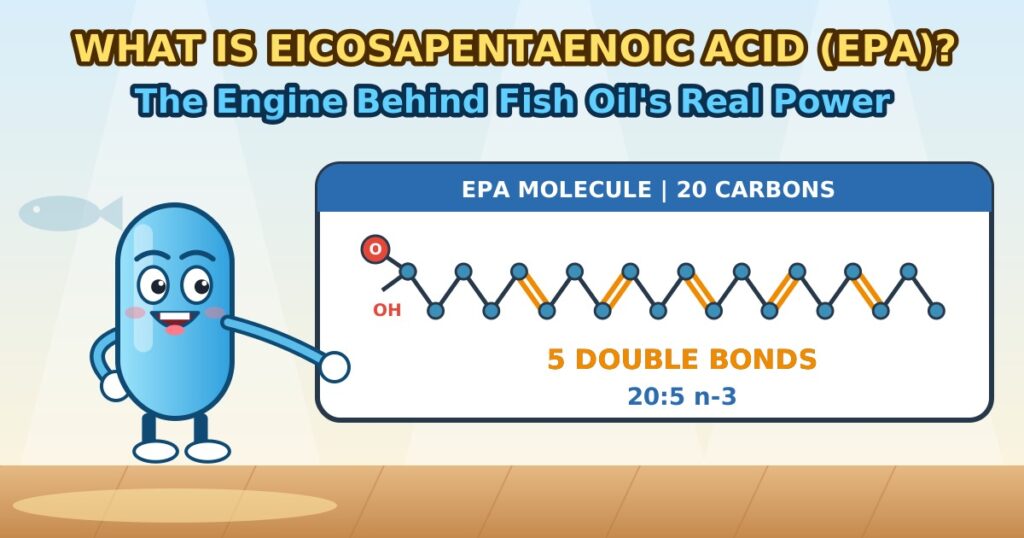
Eicosapentaenoic acid (EPA) is a 20-carbon omega-3 fatty acid with five double bonds, found mainly in oily fish and marine algae. Along with DHA, it is one of the two omega-3s that fish oil is sold for. Most labels hide the number that matters: how many milligrams of EPA you actually get.
1. Beyond generic fish oil: what EPA is
EPA is written 20:5n-3: 20 carbons, 5 double bonds, and the first double bond three carbons from the methyl end, which is what makes it an omega-3. The systematic name is all-cis-5,8,11,14,17-eicosapentaenoic acid. Each cis double bond bends the chain, so EPA molecules pack loosely and help keep cell membranes flexible.
The chemical identity of EPA
- ✔️ 20 carbons (“eicosa” means twenty)
- ✔️ 5 cis double bonds, at carbons 5, 8, 11, 14 and 17
- ✔️ Omega-3 position: first double bond at the third carbon from the methyl end
Where EPA comes from
Marine microalgae make EPA, and it moves up the food chain into oily fish such as sardines, anchovies, mackerel and salmon. Fish oil is that fat, extracted. Plant omega-3 (ALA) is a different fat: the NIH reports the body converts it to EPA and DHA at rates of less than 15%, so eating or supplementing EPA directly is the practical route. Algae oil is the plant-free source; see the vegan omega-3 guide.
Why the front label tells you almost nothing
A bottle can say “1,000 mg fish oil” and give you 180 mg of EPA, or 600 mg. The front number is the weight of everything in the softgel. The Supplement Facts panel is where EPA and DHA are listed separately. If you want the full label walkthrough, start with From Ocean to Capsule and the 1,000 mg fish oil guide.
| What the label says | What it tells you | What to look for instead |
|---|---|---|
| “1,000 mg fish oil” | Weight of the oil only | EPA mg listed on the Supplement Facts panel |
| “Total omega-3” | EPA + DHA + other omega-3s combined | EPA and DHA on separate lines |
| “High potency” | Nothing standardized | EPA per serving and per softgel |
| Serving size | Often 2 or more softgels | Check whether the EPA figure is per softgel or per serving |
2. The division of labor: EPA vs DHA
Fish oil gives you two main omega-3s, and they do different jobs. DHA is a structural fat: the NIH notes it is especially high in the retina and brain. EPA is the one researchers study most for blood fats and heart outcomes.
EPA (20:5n-3)
- Signaling: raw material for 3-series prostaglandins and E-series resolvins
- Blood fats: studied for lowering triglycerides
- Heart research: the only omega-3 in the REDUCE-IT trial
- Mood: studied, but evidence is mixed (see below)
DHA (22:6n-3)
- Structure: a building block of brain and retinal cell membranes
- Where it concentrates: retina, brain and sperm (NIH)
- Life stages: accumulates fastest in the third trimester and early childhood
- Chain: 22 carbons, 6 double bonds
How EPA competes with arachidonic acid
In cell and lab studies, EPA competes with arachidonic acid (AA), an omega-6 fat, for the same enzymes. AA is turned into 2-series prostaglandins and 4-series leukotrienes, which drive swelling and pain signaling. EPA is turned into 3-series prostaglandins and 5-series leukotrienes, which are weaker signals, plus E-series resolvins, which are involved in winding inflammation down. That is the biochemistry behind the “anti-inflammatory” label EPA gets. How much of it shows up as a health result depends on dose, diet and the person.
What the evidence says, and does not say
- Triglycerides: a meta-analysis of 58 trials found each additional 1 g/day of long-chain omega-3s lowered triglycerides by about 5.9 mg/dL, with larger drops in people who start with high triglycerides (NIH).
- Heart events: in REDUCE-IT, 4 g/day of icosapent ethyl, a prescription EPA ethyl ester, cut a composite of cardiovascular events by 25% over a median of 4.9 years in people on statins who had heart disease or diabetes plus risk factors. That is a prescription drug in a high-risk group, not proof that over-the-counter fish oil does the same.
- Mood: the NIH reports a 2015 Cochrane review found insufficient evidence that omega-3s help major depression in adults, with only a small effect on symptoms that was not clinically significant.
- Joints and everything else: this guide makes no joint-relief or other health promise. Ask your doctor about your own situation.
3. High-EPA ratios: what 3:1 and 4:1 mean
The EPA-to-DHA ratio is EPA mg divided by DHA mg. A standard fish oil sits around 1.5:1 (180 mg EPA to 120 mg DHA per 1,000 mg of oil). A “high-EPA” formula pushes that to 3:1, 4:1 or beyond, which usually means the oil has been concentrated and EPA is a larger share of it. The prescription drug in REDUCE-IT is EPA alone.
| Oil | EPA | DHA | EPA : DHA |
|---|---|---|---|
| Standard fish oil (example label, per 1,000 mg oil) | 180 mg | 120 mg | 1.5:1 |
| High-EPA example (per 1,000 mg oil) | 600 mg | 200 mg | 3:1 |
| Nature’s Way NutraSea liquid (per teaspoon) | 750 mg | 500 mg | 1.5:1 |
| Nordic Naturals ProOmega 2000 (per 2 softgels) | 1,125 mg | 875 mg | 1.29:1 |
The first two rows are worked examples, not specific products. The last two come from the labels on the product pages linked in Sources.
Why would anyone pick a higher ratio? Mostly because they want more EPA per capsule or have been told to look for EPA by a clinician. The ratio itself is not a quality score: a 3:1 oil can still be oxidized, and a 1.5:1 oil can still be a better buy per milligram of EPA. Freshness and form matter too, which is covered in the how to choose an omega-3 supplement.
Safety first at higher doses
For general dose ranges, see the omega-3 dosage guide.
4. Label math: calculate your real EPA yield
Four small calculations turn any label into a fair comparison. You need three numbers from the bottle: the serving size, the EPA per serving, and the price.
- Find the serving size. It is often 2 or more softgels, and the EPA figure is for the whole serving.
- Find EPA per softgel. EPA per serving divided by softgels per serving.
- Calculate EPA density. EPA per softgel divided by the fish oil per softgel, times 100. Only possible when the label gives the oil weight per softgel.
- Calculate cost per 1,000 mg of EPA. Price divided by (servings in the bottle × EPA mg per serving ÷ 1,000).
Worked example with two made-up bottles
| Step | Bottle A: standard | Bottle B: high-EPA |
|---|---|---|
| Price and count | $15.00, 120 softgels | $30.00, 60 softgels |
| Serving | 1 softgel | 1 softgel |
| Fish oil per softgel | 1,000 mg | 1,000 mg |
| EPA per softgel | 180 mg | 600 mg |
| EPA density | 180 ÷ 1,000 = 18% | 600 ÷ 1,000 = 60% |
| Total EPA in the bottle | 21,600 mg | 36,000 mg |
| Cost per 1,000 mg EPA | $0.69 | $0.83 |
| Softgels for 1,000 mg EPA | 5.6 | 1.7 |
Green = better in that row. Example numbers only.
The cheaper bottle wins on price per milligram of EPA, and the high-EPA bottle wins on pills per day. Which one is the better buy depends on which of those you care about, and you can only see the trade-off after doing the math.
Real products, same math
| Product | Price | Servings | EPA per serving | Cost per 1,000 mg EPA |
|---|---|---|---|---|
| Nature’s Way NutraSea (liquid) | $51.44 | 100 | 750 mg | $0.69 |
| Nordic Naturals ProOmega 2000 (softgels) | $97.95 | 60 | 1,125 mg | $1.45 |
Prices from Vitacost listings, US, checked October 12, 2026; they change often. Servings: 1 teaspoon for NutraSea, 2 softgels for ProOmega 2000.
Price is only one input. The oil form (re-esterified triglyceride vs ethyl ester) and freshness also change what you actually absorb. In a 2010 study of 72 volunteers, rTG raised blood omega-3 levels more than ethyl ester oil (124% vs 73% of natural fish oil). That trial measured blood levels over two weeks, not health outcomes.
Buying checklist
1) Read EPA in mg, not “fish oil” mg. 2) Check whether the figure is per softgel or per serving. 3) Work out cost per 1,000 mg of EPA. 4) Prefer a clearly stated oil form and third-party testing. 5) Follow the directions on the label. 6) Stay under 5 g/day EPA + DHA unless a doctor says otherwise.
Frequently asked questions
What is EPA in simple terms?
EPA is an omega-3 fat made by marine algae and stored in oily fish. It has 20 carbons and 5 double bonds, and fish oil supplements are sold mainly for their EPA and DHA content.
What is the difference between EPA and DHA?
DHA is a structural fat concentrated in the brain and retina. EPA is the omega-3 more often studied for triglycerides and heart outcomes. Most fish oils contain both.
Can my body make EPA from flaxseed or other plants?
Only in very small amounts. The NIH reports that conversion of plant ALA to EPA and DHA is less than 15%. Algae oil gives EPA directly without fish.
How much EPA is in 1,000 mg of fish oil?
It varies. A common 18/12 oil has about 180 mg of EPA per 1,000 mg, while concentrated oils can have several times more. Only the Supplement Facts panel tells you.
What is a good EPA to DHA ratio?
There is no official ideal. Standard fish oils are about 1.5:1, and some products go to 3:1 or higher. Choose by the EPA milligrams you want per day, freshness and price, not by ratio alone.
Sources
- NIH Office of Dietary Supplements, Omega-3 Fatty Acids: Fact Sheet for Health Professionals (ALA conversion, DHA in retina and brain, FDA 5 g/day, triglycerides, AFib, depression, anticoagulants, REDUCE-IT). FDA letter on EPA and DHA: fda.gov/media/128043/download.
- MDedge, REDUCE-IT: Fish-derived agent cut CV events 25%.
- SupplySide Supplement Journal, lower-dose omega-3s and AFib risk (35-study meta-analysis).
- Dyerberg J, Madsen P, Møller JM. Bioavailability of marine n-3 fatty acid formulations. Prostaglandins Leukot Essent Fatty Acids, 2010.
- Nature’s Way, NutraSea Omega-3 product page and Vitacost listing; Nordic Naturals ProOmega 2000, Vitacost listing.
Last updated October 17, 2026. This article is general information, not medical advice. Talk to your doctor before starting a high-dose omega-3 supplement, especially if you take blood thinners, have a heart rhythm condition, are pregnant or have a fish or shellfish allergy.